
Product news
Figaro sensors for Combustible and Explosive gases in Industrial Safety applications
Apr 14, 2026
Catalytic (pellistor) sensors
Across safety-critical applications such as oil and gas facilities, transmission infrastructure, power generation, and chemical processing, catalytic sensors remain the primary technology for combustible gas detection, particularly where reliable %LEL measurement, fast response, and proven fail-safe behaviour are required to trigger emergency shutdown (ESD), ventilation, and alarm systems. These environments demand sensors capable of detecting a wide range of hydrocarbons (and hydrogen where applicable), operating in ATEX-classified areas, and maintaining stable performance under harsh industrial conditions, including temperature variation, vibration, and potential exposure to contaminants. Within this context, the Figaro Engineering Inc. catalytic sensor portfolio provides robust solutions aligned to these requirements.
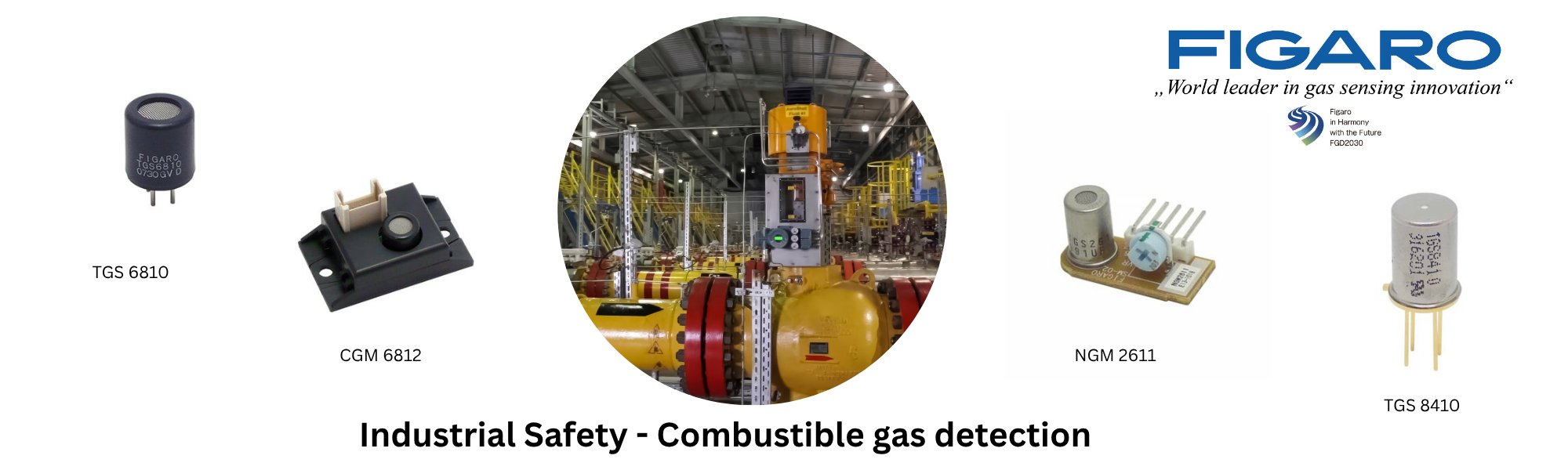
The Figaro TGS 6812 is the most suitable choice across most of these applications, particularly in oil & gas facilities, transmission infrastructure, and chemical plants, where broad hydrocarbon detection and high reliability are essential. It is designed for combustible gas detection over the full 0–100% LEL range, enabling accurate monitoring from early leak detection through to critical alarm thresholds. The sensor offers fast response times (typically within seconds) and strong linearity across the measurement range, supporting precise alarm set points required for ESD and safety interlocks. Its robust construction and resistance to environmental stress make it well suited to harsh conditions such as offshore platforms, compressor stations, and refinery process areas. In hydrogen and emerging energy applications, it also provides effective LEL-based detection, although often complemented by additional sensing technologies for enhanced sensitivity.
The Figaro CGM 6812 builds on the performance of the TGS 6812 by providing a pre-calibrated, temperature compensated module with a linearised output, significantly simplifying OEM system design. This is especially beneficial in large-scale or distributed safety systems, such as gas transmission networks, chemical plants, and hydrogen facilities, where consistent performance across multiple detection points is required. The module reduces the need for complex analogue circuitry, in-house calibration, and compensation algorithms, enabling faster development cycles, improved reliability, and lower total cost of ownership. Its integrated design also supports plug-and-play deployment and easier certification alignment, making it an attractive option for OEMs developing safety-critical gas detection systems across a wide range of industrial applications.
The Figaro TGS 6810 provides a reliable and cost-effective solution for industrial boiler houses, plant rooms, and power generation environments, where safety compliance and system integration are key drivers. Like the TGS 6812, it supports %LEL detection of combustible gases with good sensitivity and repeatability, but is typically optimised for stable, controlled environments rather than the most extreme industrial conditions. Its fast response and consistent output characteristics make it suitable for automatic gas shutoff systems, ventilation interlocks, and turbine enclosure protection, where dependable operation and integration into control systems are critical. It is particularly well aligned to commercial and industrial heating applications, where proven catalytic sensing remains the standard for compliance.
MOS (metal-oxide semiconductor) combustible gas sensors
MOS sensors are most widely used in distributed monitoring and smart sensing applications where early leak detection and trend monitoring are sufficient, large sensor networks are required, and cost, size, and power constraints are key considerations. They perform best in stable indoor or semi controlled environments and are generally not suitable as primary explosion alarm sensors under standards such as EN 60079
Across industrial safety scenarios such as energy centres, distributed gas infrastructure, plant rooms and smart buildings. MOS sensor selection is driven by the need for reliable detection of methane, LPG, and emerging hydrogen blends at concentrations well below the Lower Explosive Limit (LEL). In distributed infrastructure, including gas networks and smart city systems, requirements focus on scalability, robustness, and wide-area coverage, often using wireless or battery-powered nodes to support preventive maintenance strategies. In building-based environments, the emphasis shifts to long term stability, low maintenance, and seamless integration into BMS or IoT platforms, where MOS sensors enable cost-effective, multi-point deployment for early leak awareness. Within this context, the Figaro Engineering MOS portfolio provides a practical solution for OEMs developing scalable gas monitoring systems across both infrastructure and building based applications.
The Figaro TGS 8410 stands out as a highly suitable choice for distributed leak monitoring, smart infrastructure, and Industrial IoT applications where methane is the primary risk. It offers high sensitivity in the lower %LEL range (typically ~1–25% LEL equivalent), enabling early leak detection, along with fast response and recovery for effective real-time monitoring. Its excellent long-term stability, when supported by temperature and humidity compensation, ensures consistent performance in varying conditions. Combined with extremely low power consumption of just 0.087 mW, it is particularly well suited to battery-powered and wireless deployments, including gas distribution networks, utility tunnels, smart city systems, and remote or unmanned industrial installations.
The Figaro TGS 2611 is a highly versatile and widely adopted solution across smart buildings, plant rooms, and distributed infrastructure, offering reliable methane detection with good sensitivity below LEL thresholds and rapid response times suitable for safety applications. Its inherent cross-sensitivity to hydrogen provides additional value in evolving gas networks with hydrogen blending.
The associated Figaro NGM-2611 helps with OEM integration by providing a factory-calibrated, temperature-compensated, and linearised output, reducing the need for complex signal conditioning and calibration processes. This is particularly beneficial in large-scale deployments, such as smart buildings, utility monitoring networks, and Industrial IoT systems, where consistency, reduced development time, and simplified maintenance are key advantages.
The Figaro TGS 2610 is optimised for propane and butane detection, offering high sensitivity at low %LEL levels and stable performance across a wide operating range. This makes it well suited to boiler houses, CHP systems, and mixed-fuel environments within smart buildings and energy centres, as well as LPG monitoring in distributed infrastructure. Its robust design, combined with a zeolite filter that helps reduce the impact of interference gases, also supports reliable operation in Industrial IoT applications and more contaminated environments. The corresponding Figaro LPM-2610 provides OEMs with a pre-calibrated, compensated output, enabling “plug and play” integration, reduced calibration effort, and faster time-to-market.
The Figaro TGS 2616-C00 is specifically designed for hydrogen detection, making it central to emerging hydrogen infrastructure applications such as electrolyser buildings, storage rooms, and fuel cell manufacturing facilities. It provides excellent low-level H2 selectivity (ppm-level detection capability), combined with fast response times that are essential given hydrogen’s rapid dispersion and low ignition energy. The sensor is designed for stable indoor use and is typically deployed in networks to complement primary detection systems such as catalytic or infrared sensors. It supports cost effective multi point deployment in hydrogen installations and is well suited to methane hydrogen blend applications, helping future proof system designs.
In more demanding environments such as biogas, wastewater, and contaminated gas streams, MOS sensors offer advantages due to their resistance to catalyst poisoning and broad hydrocarbon sensitivity, enabling cost-effective multi-point monitoring. However, they are typically used as complementary sensors, with catalytic or NDIR technologies providing the primary safety layer. A similar role applies in VOC monitoring, where PID and infrared sensors dominate for precise measurement, while MOS sensors such as the Figaro TGS 1820, TGS 2600, TGS 2602, and TGS 2603 are best suited to trend monitoring, early contamination detection, and distributed sensing. They are also well aligned to portable and wearable devices, where compact size, low power consumption, and fast response support leak detection and inspection tasks.
As industrial systems evolve toward more connected and distributed architectures, MOS sensors provide a scalable and resilient solution, supporting wider monitoring coverage within layered gas detection strategies.
Figaro Engineering Inc.