
Product news
Home Safety - Residential Safety Applications for NG, LPG and Hydrogen (2)
Apr 7, 2026
Detection of flammable gases such as natural gas (NG), liquefied petroleum gas (LPG), and increasingly hydrogen (H₂) is critical to residential safety, aimed at preventing explosions and fire hazards caused by gas leaks. In Europe, gas detection systems are typically designed to trigger alarms well below dangerous concentrations, at around 10 - 20% of the Lower Explosive Limit (LEL). This requires sensors with high sensitivity, fast response times, and strong selectivity to minimise false alarms. Application requirements vary by gas type: natural gas (methane) detection is most relevant in homes with mains gas supply, particularly around boilers, cookers, and meters; LPG (propane/butane) detection is essential in properties using bottled gas, mobile homes, and caravans where gas can accumulate at low levels due to its higher density; and hydrogen detection is becoming increasingly important with the growth of hydrogen blending and future residential energy systems, where its low molecular weight and high diffusivity demand rapid response sensing near ceilings or in enclosed spaces.
Globally, residential gas safety requirements are well established, with widespread adoption of combustible gas alarms in markets such as Japan and the USA, where they have significantly reduced gas-related incidents. This proven track record is now driving increased uptake across Europe, particularly as infrastructure evolves to support hydrogen-ready systems. While dedicated flammable gas detectors remain essential, there is growing demand for combined CO and combustible gas alarms, particularly in environments where both toxic and explosive risks coexist - such as kitchens, boiler rooms, garages, and apartments with gas appliances. In these applications, a single device can monitor carbon monoxide from incomplete combustion alongside gas leaks, offering simpler installation, lower system cost, and more comprehensive protection compared to separate detectors, making them an increasingly attractive solution for modern residential safety design. See Home Safety - Residential Safety Applications of CO and Multi-Gas Sensors (1)
This article explores the range of Figaro flammable gas sensors used in residential safety applications for NG, LPG, hydrogen blends and hydrogen, highlighting how these technologies contribute to safer homes and support evolving safety standards worldwide.
In Europe, residential flammable gas detectors are mainly defined by EN 50194-1, which defines performance requirements for detecting natural gas, LPG, and, in its latest revision, hydrogen, including typical alarm thresholds around 10 - 20% of the LEL, response times, and reliable operation under varying environmental conditions. Its extension, EN 50194-2, covers mobile environments such as caravans and boats, while EN 50244 provides guidance on correct installation and usage. Although these standards apply at the detector level, they impose clear requirements on the underlying sensor, which must reliably detect gases well below alarm thresholds (3–20% LEL) with accuracy of around ±2.5% to ±5% LEL, fast response (within seconds), and stable performance over several years. Sensors must also operate reliably across temperature, humidity, and, where applicable, vibration, while minimising interference from VOCs, alcohol vapours, and other household contaminants. While CE marking is mandatory for devices sold in Europe, there is currently no harmonised EU wide legislation requiring installation in all homes, with regulations varying by country. However, as hydrogen becomes more prominent in residential energy systems, both standards and regulatory pressure are expected to evolve further in line with decarbonisation and safety initiatives.
Metal oxide semiconductor (MOS) sensors for Natural Gas alarms
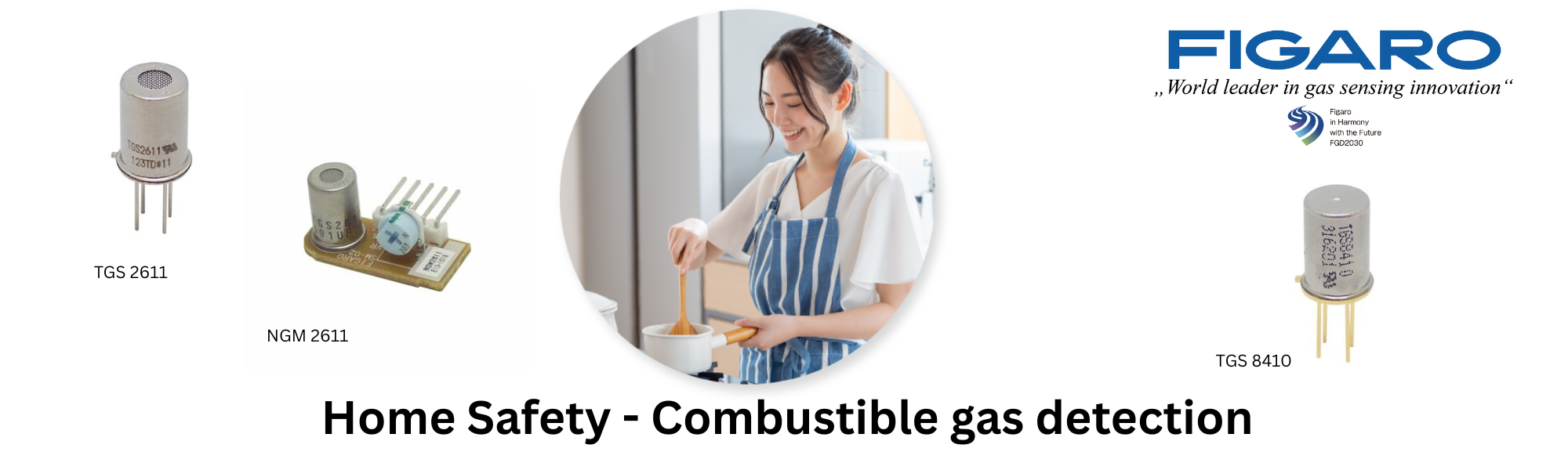
The Figaro TGS 8410 is a next-generation MOS sensor optimised for residential gas detection in line with EN 50194 requirements. It offers high sensitivity to methane with good selectivity, in-cluding resistance to common interferents such as alcohol vapours, helping to minimise false alarms. The sensor delivers a fast response suitable for leak detection while maintaining stable performance over a typical five-year lifetime. Its MEMS design enables ultra-low power con-sumption of approximately 0.087 mW, making it ideal for battery-operated and wireless detec-tors, while its small footprint supports modern, space-efficient designs. Overall, the TGS 8410 provides an excellent balance of performance, stability, and energy efficiency for residential ap-plications.
Alternative MOS sensors and pre-calibrated modules
The Figaro TGS 2611 is a long established MOS sensor widely used in residential gas detectors designed to meet EN 50194 requirements. It provides high sensitivity to methane with reliable response characteristics suitable for detecting gas leaks in domestic environments. The sensor offers good long-term stability, typically around five years, and incorporates filtering to reduce sensitivity to interfering gases such as alcohol vapours. While its power consumption is higher than MEMS-based alternatives at approximately 280 mW, it remains a cost-effective and proven solution, making it a popular choice for mains-powered detectors and applications where power consumption is less critical.
Figaro supply a pre-calibrated module, the NGM 2611 to simplify the development of residential gas detectors and ensure consistent performance. By eliminating the need for complex, time-consuming calibration processes, it allows manufacturers to achieve reliable alarm set points (typically around 10% LEL) straight out of the box, reducing production cost, time, and the risk of miscalibration.
The module integrates the proven Figaro TGS 2611 with built-in signal conditioning, temperature compensation, and a pre-adjusted load resistor to maintain stable output across environmental conditions. It provides a simple voltage output, operates from a standard 5 V supply, and is designed for typical residential environments (0–40°C, up to 95% RH). With an internal filter to minimise interference from alcohol vapours and other contaminants, and a compact, plug-and-play design, the NGM 2611 offers a reliable and efficient solution that meets the performance requirements of EN 50194-1 and UL 1484 for residential natural gas detection.
MOS sensors for LPG alarms
The Figaro TGS 2610 is a well proven metal oxide semiconductor sensor specifically designed for LPG detection (propane and butane) in residential alarms compliant with EN 50194. It offers high sensitivity within the critical low %LEL range required for early leak detection, combined with fast response characteristics suitable for both rapid and gradual gas build-up. The sensor incorporates an internal filter (in the -D00 variant) to reduce cross-sensitivity to alcohol and household vapours, supporting the standard’s requirement for low false alarm rates. With a typical lifetime of around five years, low power consumption (280 mW), and a compact TO-5 package, it provides a robust and cost-effective solution for domestic detectors. Its proven field performance, combined with conformity to EN 50194, makes it particularly well suited to mains-powered residential LPG alarms where reliability and affordability are key.
As with the TGS 2611 methane sensor above, Figaro offer a factory-calibrated solution for the LPG sensor which meets the performance requirements of EN50194, greatly reducing design and calibration effort. This is the LPM 2610 module.
Where Catalytic Sensors Complement MOS Technology
Although MOS sensors optimised for low %LEL detection remain the most practical and widely used solution for residential alarms, there are instances where a catalytic sensor such as the Figaro TGS 6810 is more suitable owing to its fast response and accurate, linear measurement across a wide range up to 100% LEL. E.g. higher-risk settings such as boiler or plant rooms, larger properties with multiple gas appliances, or enclosed spaces like basements and garages where gas can accumulate to higher concentrations.
MOS sensors for both hydrogen blends and hydrogen alarms
In Europe, residential hydrogen adoption is expected to begin with natural gas and hydrogen blends rather than pure hydrogen. Existing infrastructure can generally support up to 20% H₂, making this the most likely initial scenario for boilers and cooking.
Hydrogen introduces new detection challenges: it diffuses faster than methane, accumulates at high levels, and ignites more easily. EN 50194-1 and EN 50194-2 now include hydrogen alongside natural gas and LPG, covering applications such as blended gas and fuel cells. This update introduces hydrogen-specific testing (e.g. ignition behaviour and cross-sensitivity) and improved requirements for stability, environmental robustness, and end-of-life indication, aligning structurally with CO alarm standards. However, the standards remain based on %LEL detection, increasing the need for fast, accurate, and reliable sensors across mixed gases.
Further revisions are expected as the use of hydrogen grows, including tighter requirements for response time and sensitivity, clearer mixed-gas calibration and testing, and updates covering durability, poisoning resistance, installation guidance, and test gas standardisation.
For blended gas detection, sensors must reliably alarm at 10–20% LEL, respond within seconds to both rapid and gradual leaks, and maintain performance across varying methane/hydrogen ratios, resist interference from household contaminants, and remain robust over time and environmental conditions. Metal oxide semiconductor sensors are well suited due to their sensitivity, fast response and durability: the Figaro TGS 2611 provides proven methane detection, while the Figaro TGS 2616-C00 adds targeted hydrogen sensitivity, enabling effective coverage of blended fuels.
The TGS 2616-C00 provides high sensitivity to hydrogen in the critical low %LEL range, with fast response characteristics and stable performance over its lifetime (≥ 5 years). Its design offers good selectivity and resistance to interferents, supporting low false alarm rates in residential environments, while maintaining reliable operation across standard temperature and humidity ranges. This sensor provides a robust and future-proof solution for the detection of hydrogen as residential gas standards continue to evolve.
Catalytic sensors, such as the Figaro TGS 6812, also meet EN 50194, offering fast, linear response up to 100% LEL. However, higher power consumption and lower selectivity make them less suitable for compact or battery-powered alarms.
Overall, MOS sensor solutions provide the best balance of sensitivity, robustness, selectivity, and efficiency for hydrogen-blended residential applications.
Figaro Engineering Inc.