
Product news
Design Considerations for Lead-Free Oxygen Sensing Using the Figaro TGS4260
May 15, 2026
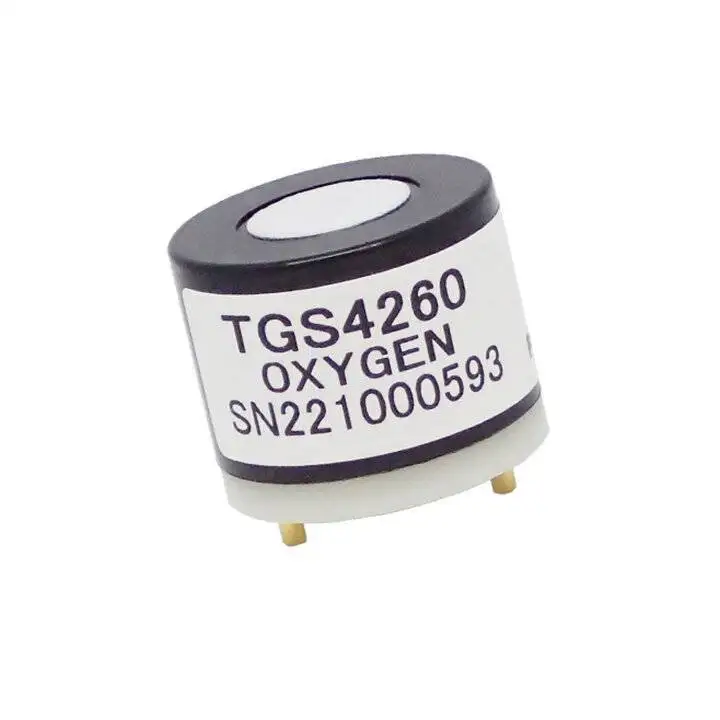
The Figaro TGS4260 is designed for oxygen monitoring applications where stable measurement behaviour, high repeatability, and dependable long-term performance are prioritised over rapid power-up operation. Its potentiostatic lead-free electrochemical sensing principle, combined with low drift characteristics and strong linearity across the operating range, makes it suitable for both portable and fixed instrumentation used in inerting systems, confined-space monitoring, oxygen deficiency monitoring (ODM), gloveboxes, laboratory safety systems, and industrial process monitoring applications.
The sensor is particularly well suited to instruments requiring stable calibration behaviour and accurate oxygen measurement with minimal signal conditioning complexity. Unlike many electrochemical oxygen sensors that rely on logarithmic correction or multi-point digital linearisation, the TGS4260 exhibits a highly linear output response across its specified operating range. This allows designers to implement simpler analogue front-end circuitry and more straightforward calibration strategies while reducing firmware complexity and minimising potential inaccuracies introduced by digital compensation.
How the sensor functions
The operating principle of the Figaro TGS4260 is based on a three-electrode potentiostatic electrochemical cell. The sensor comprises a working electrode (WE), counter electrode (CE), and reference electrode (RE), all in contact with a liquid electrolyte and housed within a sealed, gas-permeable structure. Oxygen diffuses through a membrane to the working electrode, where the sensing reaction takes place on a noble metal catalyst surface.
During operation, an external potentiostatic circuit maintains the working electrode at a fixed negative potential relative to the reference electrode. Under these controlled conditions, oxygen is reduced at the working electrode, while a corresponding oxidation reaction occurs at the counter electrode. These reactions generate an electrochemical current, with ionic conduction occurring through the electrolyte and electron flow through the external circuit.
Because the rate of oxygen reduction is directly proportional to the amount of oxygen reaching the working electrode, the resulting current is proportional to the ambient oxygen concentration. This current is then converted into a voltage signal by the measurement electronics, providing a stable and repeatable output that accurately reflects oxygen levels without the need for complex signal linearisation.
Raw Sensor Characteristics
From a system design perspective, one of the most important attributes of the Figaro TGS4260 is its highly linear output across the full measurement range under standard test conditions using the recommended measuring circuit the sensor exhibits an almost directly proportional relationship between output current and oxygen concentration from 0 to 25 vol.% O₂. The Sensor Response curve shows only minimal deviation from ideal linearity throughout the operating range, allowing designers to implement straightforward current-to-concentration conversion without the logarithmic compensation or multi-point linearisation often associated with other electrochemical oxygen sensors. In practical instrument design, this reduces firmware complexity, simplifies calibration routines, and minimises potential inaccuracies introduced by digital compensation.
Dynamic response behaviour is equally important in oxygen safety instrumentation. When transitioning from 100% nitrogen back to ambient air, the sensor reaches approximately 90% of its final output in around 10 seconds. The response is stable and predictable, with little overshoot or oscillation, simplifying alarm threshold implementation and reducing the need for extensive signal filtering.
The sensor output approaches near-zero current in nitrogen and reaches approximately -120 µA in ambient air (~20.9% O₂), providing a useful signal span for stable amplification and high-resolution ADC conversion without excessive gain. Combined with the recommended 20 Ω load resistor, this supports good noise immunity and stable low-level measurement performance.
Repeatability characteristics are particularly strong. During repeated cycling between nitrogen and ambient oxygen, the response shows minimal baseline shift or variation between cycles indicating stable electrode behaviour. For portable and fixed gas detection systems, this supports reduced recalibration frequency and improved confidence in alarm performance.
The TGS4260 is well suited to mixed-gas environments due to its low cross-sensitivity to common interfering gases. Even exposure to 5,000 ppm hydrogen causes only a modest apparent shift in oxygen reading. This high selectivity helps maintain measurement accuracy while reducing the need for complex software compensation in multi-gas instruments and environments where background gases may fluctuate significantly.
Temperature characteristics further support the sensor’s suitability for industrial applications. Output variation with temperature is gradual and predictable, allowing compensation to be implemented using a simple NTC thermistor rather than complex compensation models. The response is rapid, and remains relatively stable at around 3 seconds over a wide temperature range of 0 - 60˚C, below which it slows gradually.
Long-term stability is particularly important for OEMs focused on lifecycle cost and maintenance planning. Over a test period of nearly two years, oxygen readings remained close to the nominal 20.9% reference point with minimal drift, supporting extended calibration intervals and reduced maintenance requirements in fixed systems.
Mechanical robustness is another important characteristic. Following repeated 2 m drop tests within a handheld instrument enclosure, no significant change in response behaviour or recovery characteristics was observed. This strong resistance to mechanical shock supports the sensor’s suitability for use in demanding field environments..
Taken together, these measured characteristics demonstrate a sensor design optimised for stable, low drift oxygen measurement with minimal signal conditioning complexity. For instrument designers, the combination of linear output, high repeatability, low cross-sensitivity, stable temperature behaviour, and excellent stability over time can significantly simplify both hardware and firmware development while supporting robust long term instrument performance.
Figaro Engineering Inc.