
Product news
Home Safety - Residential Safety Applications of CO and Multi-Gas Sensors (1)
Mar 31, 2026
Modern home safety relies increasingly on intelligent sensing technologies capable of detecting invisible and potentially life-threatening hazards. Among these, gas sensors play a critical role in protecting occupants from risks such as fire, toxic exposure, and explosive atmospheres. Solutions from Figaro have become widely adopted across residential safety applications, enabling early detection of carbon monoxide (CO), flammable gases such as natural gas (NG) and liquefied petroleum gas (LPG), and more recently emerging fuels such as hydrogen (H₂).
The importance of these technologies is underscored by safety data across Europe and beyond.
Residential fires and gas-related incidents remain a significant risk, with approximately 5,000 fire-related deaths occurring annually in Europe, most of them in homes. However, the widespread introduction of gas and smoke detection systems has had a measurable impact. Fire fatalities in Europe have fallen by around 65% over the past 30 years, largely due to improved safety regulations and the adoption of detection technologies.
Carbon monoxide remains another critical hazard, often undetectable without sensors. Globally, CO exposure causes tens of thousands of deaths annually, including hundreds in Western Europe alone, while in some regions of Eastern Europe, thousands of deaths each year are still linked to heating and cooking technologies. The integration of CO sensors into dedicated alarms and combined fire detection systems is therefore a key element of modern home safety strategies.
In addition to toxic and combustible gas detection, there is growing recognition of the role of indoor air quality in overall wellbeing. Carbon dioxide (CO₂) sensors, while not directly linked to acute safety hazards in the same way as CO or flammable gases, are increasingly used to monitor ventilation and reduce long term health risks, positioning them at the intersection of safety, comfort, and energy efficiency.
Two articles explore the range of Figaro gas sensors used in residential safety applications, from CO detection in alarms and fire systems (1) to flammable gas monitoring for NG, LPG, and hydrogen (2) highlighting how these technologies contribute to safer homes and support evolving safety standards worldwide.
Dedicated CO alarms
For residential CO alarms certified to UL 2034 and EN 50291, the gas sensor element must reliably detect carbon monoxide across a low ppm range with stable, repeatable performance over time.
In both standards, the sensor must resolve concentrations as low as 30 ppm without triggering an alarm, while accurately supporting alarm thresholds starting at 50 ppm (EN 50291) and 70 ppm (UL 2034). It must enable the system to meet defined response times which are stricter in the case of EN 50291; 50 ppm within 60 - 90 minutes, 100 ppm within 10 - 40 minutes, and 300 ppm in under 3 minutes. To achieve this, the sensor typically needs good in the critical 30 - 100 ppm range, along with low baseline drift over a 5 - 10 year lifetime. It must also operate reliably across environmental conditions of roughly 0°C to 40–50 °C and up to 90–95% relative humidity, while minimising cross-sensitivity to interfering gases such as hydrogen and alcohol vapours to avoid false alarms.
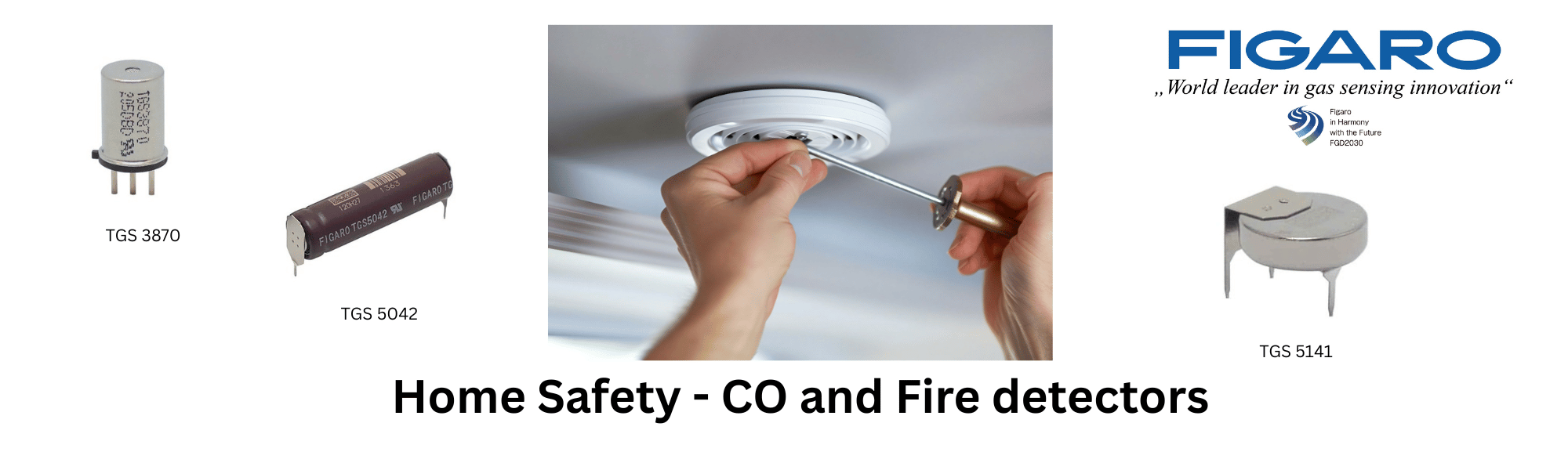
The RoHS-compliant TGS 5141 is ideally suited to residential CO detection, meeting the requirements of UL 2034 and EN 50291. It offers excellent long-term stability, high sensitivity, and strong selectivity to carbon monoxide. The sensor operates over a typical measurement range of 0 to 5,000 ppm, with a fast response time (T90) of under 60 seconds, and provides a linear current output proportional to gas concentration.
Not only does it deliver high performance, but the TGS 5141 is also the world‘s smallest electrochemical CO sensor, measuring just 14 mm in diameter and 5 mm in height. This compact design is achieved through the use of a unique electrolyte that eliminates the need for a water reservoir, reducing its size by 90% and weight down to just 2.5 grams compared to its predecessor, the TGS 5042.
The sensor is self-powered, generating the energy required for operation while the measuring circuit electronics consume only a few microamps. With an expected lifetime of over ten years, it is particularly well suited to battery-operated residential CO alarms. Each unit is supplied with individual sensitivity data, removing the need for additional calibration during installation and simplifying system integration.
Combining long operational life, compact size, and competitive cost, the TGS 5141 offers an efficient and cost-effective solution for modern CO detection systems.
Alternative sensors from the Figaro CO electrochemical product family
The popular TGS 5042 and its derivative, theTGS 5043, with its extended operational temperature range of -40°C to +70°C , are also characterised by high stability and durability and meet UL 2034 and EN 50291 standards. Although superseded, in many instances by the TGS 5141 for use in residential alarms, they remain popular in instances where the temperature falls below 0°C, e.g. for underground parking garages and for non-domestic applications. Precalibrated modules (CMM 5042) are available.
Residential Fire alarms
The TGS 5141 mentioned above also meets EN54-31 CO sensor requirements for use in fire detection systems where the sensor must respond to much faster changes in CO concentration, often around ~60 ppm alarm thresholds with no response below ~25 ppm, and detect dynamic fire signatures such as smouldering and flaming conditions . This places greater emphasis on fast response time (low T90), “rate of rise sensitivity”, and very high immunity to interferences (e.g. alcohols, hydrocarbons, or CO₂ up to ~5000 ppm.
Residential Multigas alarms
Residential multi-gas alarms that combine carbon monoxide (CO) detection with flammable gas sensing such as methane (CH₄) and increasingly hydrogen (H₂), provide a more comprehensive approach to home safety by addressing both toxic and explosive hazards in a single device. These systems are typically used in environments where fuel-burning appliances are present, for example in kitchens, boiler rooms, garages, and mobile homes, where there is a risk of CO from incomplete combustion as well as leaks of natural gas or hydrogen. Unlike single gas alarms, multigas solutions can simultaneously monitor multiple threats, improving overall safety coverage with no additional installation effort and with minimal cost.
The Figaro TGS 3870 is particularly well suited to residential multi-gas alarms, as it enables the detection of carbon monoxide (CO), methane (CH₄), and hydrogen (H₂) within a single sensing platform, eliminating the need for multiple discrete sensors. This simplifies system design, reduces size and power consumption, and allows simultaneous monitoring of both toxic and explosive gas hazards, an increasingly important capability as homes adopt mixed and hydrogen based energy sources. The sensor operates using a microbead metal oxide semiconductor (MOS) principle, where changes in electrical conductivity occur when exposed to target gases. By periodically cycling between high and low heater voltages, the TGS 3870 selectively detects CO in the 50–1000 ppm range and methane and hydrogen in the 1–25% LEL range, independently of one another. These gases, being reducing in nature, undergo oxidation at the sensor surface, releasing electrons and decreasing resistance, which is then converted into a measurable signal proportional to gas concentration. With a low average heater power consumption of just 38 mW, along with strong resistance to VOCs and siloxanes, the TGS 3870 offers a compact, robust, and energy efficient solution ideally suited to modern residential multi-gas safety applications
Figaro Engineering Inc.