
Product news
Figaro Engineering’s FCM2610 (R290) and FCM2630 (R32) gas sensor modules for reliable refrigerant leak detection.
May 5, 2026
Refrigerants are essential across a wide range of applications where temperature control, cooling, or freezing is required, including HVAC systems in residential and commercial buildings, heat pumps, refrigeration systems, industrial and transport cooling, air conditioning in vehicles and aircraft, and specialised cooling for data centres, industrial processes, and medical uses. However, when these substances leak, they can have a significant environmental impact. Many refrigerants contribute to global warming by trapping heat in the atmosphere, while others are linked to ozone depletion and smog formation.
The climate effect of a refrigerant is typically measured by its global warming potential (GWP) relative to carbon dioxide (CO₂); the higher the GWP, the greater its contribution to warming. With global refrigerant consumption estimated at 1.97 million tonnes in 2023 and projected to rise to 2.29 million tonnes by 2029, the need to manage these emissions is becoming increasingly urgent. The use of CFC refrigerants, many with GWPs in the thousands, has been eliminated through regulation, followed by HCFCs due largely to their impact on the ozone layer. More recently, attention has shifted to reducing high GWP HFCs and transitioning to more sustainable, low-GWP alternatives such as HFOs and natural refrigerants (e.g. CO₂, ammonia, and hydrocarbons).
F-Gas Regulation (EU) 2024/573
In the EU and N. Ireland, the F-Gas Regulation, so named because it governs the handling of fluorinated greenhouse gases (F-gases), sets the target of reducing their emissions to zero. On 11 March 2024, Regulation (EU) 2024/573 came into force, replacing Regulation (EU) No 517/2014. ( Note that the UK, whilst retaining the earlier regulation has not implemented the latest rules but is developing its own approach and an updated regulation is expected shortly.)
As a result of the latest regulation, from 2025, only refrigerants with a GWP of 750 or less may be used in air conditioning systems, industrial refrigeration systems and heat pumps. Manufacturers of these devices must look to alternative refrigerants with lower GWP values, such as R32, R290 (propane) or R744 (CO₂).
R32 has been used as a fluorocarbon for some time and accounts for 50% of the commonly used refrigerant blend R410A, which is still widely used in heat pumps. In addition to its lower GWP of 675 compared to 2088 for R410A, R32 also has a higher system efficiency. This means that less energy is required to achieve the same cooling. This results in lower electricity consumption, lower emissions and lower operating costs.
Propane (R290) with a GWP of just 3, is frequently used in heat pump systems.
Requirements for leak detection with R290 and R32
When it comes to refrigerants with a low global warming potential, it remains essential to implement robust safety standards to prevent leaks and ensure safe disposal.
To address these issues, organisations such as the IEC have established guidelines and standards such as IEC TS 63542 ed.1.0 and UL 60335-2-40 ed.4. These standards cover safety requirements, limits on refrigerant charge and environmental considerations.
Compliance with these regulations is key to safe and efficient operation of heat pumps that use the refrigerants R-290 (propane) and R-32. These refrigerants have a lower environmental impact but require careful handling due to the risk of flammability.
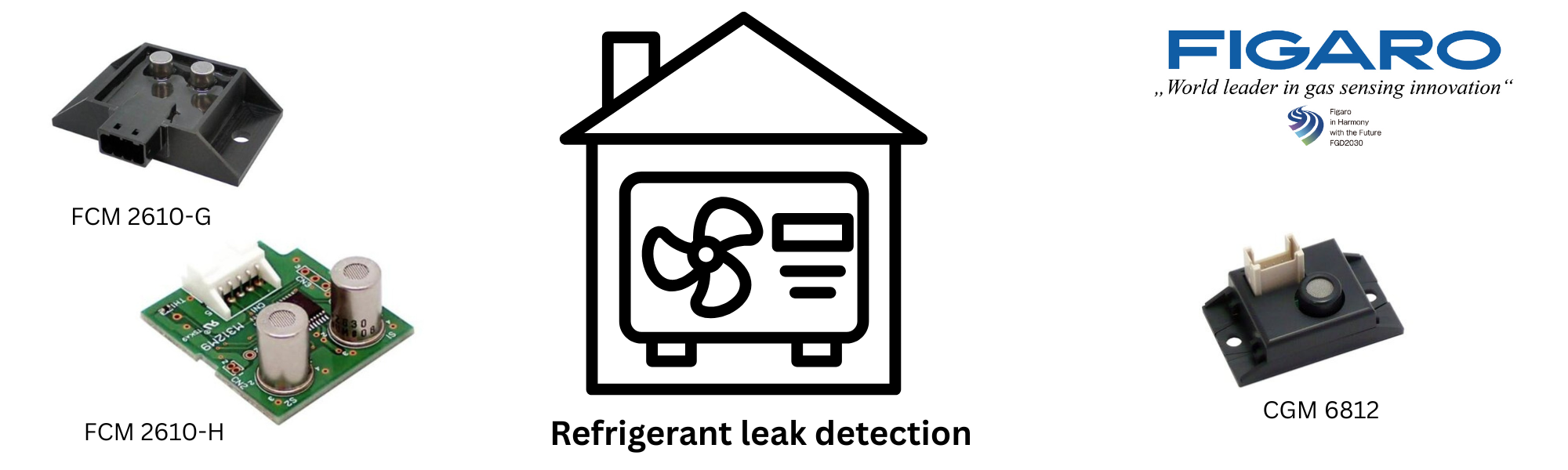
Figaro Engineering offers pre-calibrated R290 and R32 sensor modules to monitor systems using either of these refrigerants for leaks.
The FCM 26xx refrigerant gas sensor modules from Figaro Engineering Ltd.
The FCM 2610 and FCM 2630 sensor modules from Figaro Engineering Inc. are specifically designed for the detection and monitoring of refrigerant gases in air conditioning systems and heat pumps, helping to protect both the environment and the safe operation of HVACR (heating, ventilation, air conditioning and refrigeration) systems.
The FCM 2610 module is factory-calibrated for R-290, while the FCM 2630 is calibrated for R-32. Both modules incorporate gas sensors with built-in filters to minimise the influence of alcohol and other interfering gases. They also feature dual-sensor architecture for extended service life, along with integrated temperature compensation to reduce the effect of ambient temperature fluctuations on alarm accuracy.
These compact “plug-and-play” embedded-type modules are easy to integrate into both new and existing gas leak detection systems. Support is provided for UART and I²C digital communication interfaces, along with an open-collector output for monitoring, alarm, and fault signals. Compliance with key industry standards, including IEC TS 63542, UL 60335-2-40, and JRA4068, is ensured, and the modules are also RoHS-compliant.
At the core of these modules are the proven TGS2610 and TGS2630 MOS sensors, which offer long service life and low operating costs, making them a reliable and cost-effective solution for refrigerant leak detection.
The CGM 6812 module for flammable gases
The CGM 6812 is a pre-calibrated, temperature compensated module with a linearised output. It employs the popular TGS6812 catalytic sensor, which detects propane, hydrogen, methane and LPG, and is suitable for detecting gas leaks in stationary heat pumps using propane refrigerant.
Figaro Engineering Inc.