
Product news
Built for Launch: Why Direct RF Sampling Wins for Missile and Rocket Telemetry Recording
Apr 10, 2026
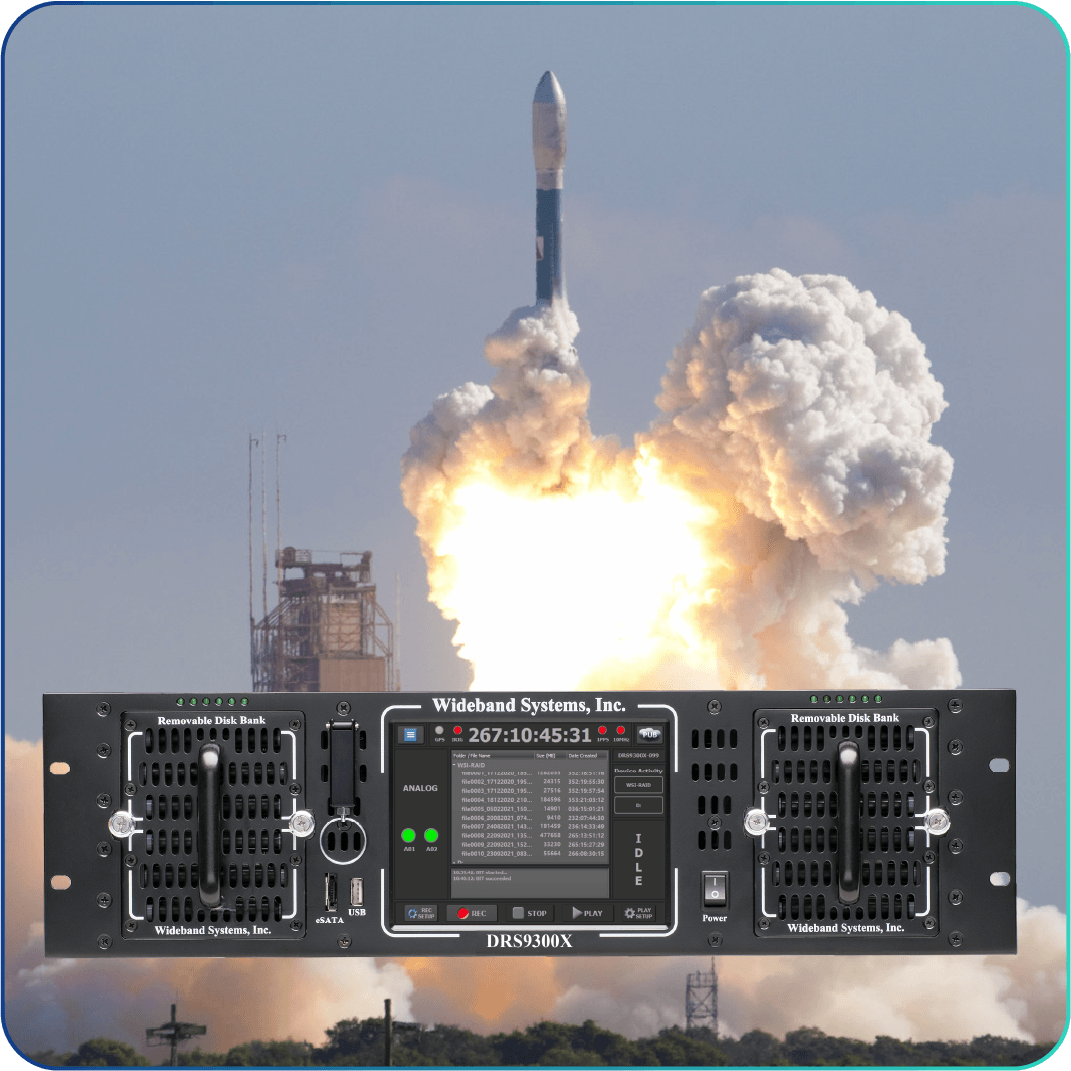
Missile and rocket telemetry is unforgiving. Signals are narrow, frequencies can move, environments are noisy, and you rarely get a second shot if something goes wrong. Traditional down-conversion architectures with multiple analog stages make it harder than it needs to be.
The WSI DRS9300X Multi-Band recorder solves these problems by using Direct RF Sampling, capturing telemetry signals across a wide frequency range without intermediate analog IF stages. This architecture simplifies the signal path, improves fidelity, and increases reliability in harsh launch environments. Below are four common challenges and how the DRS9300X-MB addresses each one.
Challenge: Your signals are narrow, but you need a wide capture window
Missile and rocket telemetry channels may only be on the order of ~20 Mbps (about 20–40 MHz of occupied bandwidth), but your uncertainty window is much wider. Doppler shift, multi-carrier test scenarios, or unknown exact frequencies during launch can easily push you into a 50–220 MHz capture range.
The DRS9300X-MB advantage:
With Direct RF Sampling, the recorder can capture a wide instantaneous RF bandwidth without analog retuning, filter swapping, or band-by-band front ends. One digital front end lets you cover the full mission window, including Doppler and multi-carrier scenarios, while still resolving the narrow telemetry waveform you care about.
Challenge: You cannot afford phase errors or distortion
Accurate demodulation of telemetry formats like PCM/PSK, SOQPSK-TG, or FM/FM depends on clean phase and amplitude characteristics. Traditional analog I/Q chains introduce mixer imbalance, LO phase noise, and filter distortion that can degrade bit error rate and corrupt phase measurements right when you need them most.
The DRS9300X-MB advantage:
Direct RF Sampling takes the RF carrier straight into high-speed ADCs and moves the critical processing into the digital domain. That approach eliminates many analog I/Q error sources, preserves phase coherence, and gives downstream demodulators a cleaner signal to work with, improving link margin and measurement confidence.
Challenge: Launch environments are noisy
Launch and range environments inflict vibration, temperature swings, shock, and EMI. Classic architectures with multiple mixers, LOs, and analog filters are harder to keep aligned and calibrated over time. Each analog stage is another point of drift, failure, or mis-tune during critical events.
The DRS9300X-MB advantage:
By minimizing analog stages and moving complexity into digital signal processing, the DRS9300X-MB reduces the number of components that can drift or fail. Fewer analog blocks mean higher inherent reliability, less maintenance, and no recurring alignment routines, which is exactly what you want on high-consequence launch campaigns.
Challenge: Your frequency requirements keep expanding
As telemetry moves higher in frequency and uses more complex modulation, legacy IF-based recorder architectures can become harder to scale. Modern high-speed ADCs and Direct RF approaches, already proven in radar, EW, SIGINT, and advanced flight test systems, make it possible to capture across broader portions of the spectrum with fewer compromises.
The DRS9300X-MB advantage:
The DRS9300X-MB applies that same Direct RF approach to telemetry recording, giving you one recorder that scales across the 100 MHz to 6 GHz spectrum without requiring a new hardware redesign each time requirements move up-band. As missions evolve, you adjust digital configurations and processing, not racks of analog gear, so the same recorder can support today’s launches and tomorrow’s telemetry needs.
Putting Direct RF to Work on Your Range
Direct RF Sampling is not just a clever architecture choice; it is the ideal approach to make missile and rocket telemetry recording more robust, more flexible, and easier to maintain. The WSI DRS9300X Multi-Band recorder gives you wide capture bandwidth for uncertain RF environments, cleaner signals for demodulation, higher reliability under launch conditions, and a path forward as telemetry standards continue to evolve.
Ready to see how Direct RF fits into your range or launch campaign?
Contact Wideband Systems to review your telemetry bands, data rates, and mission profiles. With support from 100 MHz to 6 GHz, the DRS9300X-MB gives you one Direct RF recording platform that can be applied across a wide range of launch and flight test applications.
Delta Information Systems, Inc.