
Produkt-Neuheit
Das sich weiterentwickelnde Ökosystem für Wasserstoffsicherheit
24.04.2026

Das Sicherheitsökosystem für Wasserstoff vereint Sensortechnologien, einschlägige Normen und Konstruktionspraktiken auf Systemebene, die gewährleisten, dass Wasserstoff in einer Vielzahl von Anwendungsbereichen sicher erzeugt, gespeichert, transportiert und genutzt werden kann. Es deckt alles ab, von Elektrolyseuren und wasserstoffbetriebenem Verkehr bis hin zu Tankstellen, Industrieanlagen und Energieversorgung für Privathaushalte, gestützt durch solide sicherheitstechnische Verfahren, gesetzliche Anforderungen und bewährte Lösungen zur Gasdetektion. Wasserstoff findet im Rahmen der europäischen Energiewende zunehmend Verbreitung, wo er als sauberer Energieträger, industrieller Rohstoff und Speichermedium in einer Reihe von Dekarbonisierungsanwendungen dient. Die physikalischen Eigenschaften von Wasserstoff – darunter seine Farblosigkeit, Geruchlosigkeit, hohe Diffusionsfähigkeit und Entflammbarkeit über einen weiten Konzentrationsbereich – stellen jedoch im Vergleich zu herkömmlichen Kraftstoffen besondere sicherheitstechnische Herausforderungen dar.
Warum stellt Wasserstoff im Vergleich zu anderen brennbaren Gasen ein so großes Sicherheitsrisiko dar?
Die untere Zündgrenze (UEG) von Wasserstoff in Luft liegt bei etwa 4 %, was bedeutet, dass bereits relativ geringe Leckagen brennbare Gemische bilden können. Da Wasserstoff schnell aufsteigt und sich ausbreitet, konzentrieren sich die Risiken häufig auf geschlossene oder halbgeschlossene Räume wie Decken, Gerätegehäuse oder beengte industrielle Umgebungen. Wasserstoffsensoren sind nicht nur Überwachungsinstrumente, sondern aktive Vorrichtungen zur Risikominderung, die in der Lage sind, Alarme, Belüftung oder eine Systemabschaltung auszulösen, bevor die Konzentrationen gefährliche Werte erreichen.
Umfang des Wasserstoff-Ökosystems
Das Wasserstoff-Ökosystem umfasst eine Vielzahl von Anwendungsbereichen, die jeweils spezifische Sicherheitsaspekte mit sich bringen:
• Gewerbliche und energetische Infrastruktur: Elektrolyseanlagen, Speicheranlagen, Verteilungsleitungen und Wasserstofftankstellen.
• Verkehr: Brennstoffzellen-Elektrofahrzeuge (FCEVs), Busse, Züge, Seeschiffe und neue Anwendungen in der Luftfahrt.
• Industrie: Raffinerien, Ammoniakproduktion, Stahlherstellung und chemische Verarbeitung, wo oft große Mengen, hohe Drücke und komplexe Anlagenumgebungen eine Rolle spielen.
• Privathaushalte und dezentrale Energieversorgung: Einmischung von Wasserstoff in Gasnetze, Heizkessel und brennstoffzellenbasierte Kraft-Wärme-Kopplungsanlagen (KWK).
Wie eine Reihe europäischer Initiativen – darunter von der EU finanzierte Forschungsprogramme, Industriepartnerschaften und Normungsgremien – deutlich machen, hängt der Erfolg von Wasserstofftechnologien unmittelbar von der konsequenten Einbindung von Sicherheitsmaßnahmen in die Systemkonzeption und den Betrieb ab.
Regulierungs- und Normenumfeld
In Europa wird die Sicherheit im Umgang mit Wasserstoff durch eine Kombination aus Richtlinien, Normen und branchenspezifischen Vorschriften geregelt. Für Gasmessgeräte sind vor allem die ATEX-Richtlinien relevant, die sich auf Geräte (2014/34/EU) und die Sicherheit am Arbeitsplatz (1999/92/EG) beziehen. Diese legen Anforderungen für den Betrieb in explosionsgefährdeten Bereichen fest und werden durch Normen wie die EN 60079-Reihe ergänzt. Zusammen legen diese Rahmenwerke Anforderungen an Lecksuche, Alarmsysteme, Belüftung, Materialverträglichkeit und Risikobewertung für verschiedene Anwendungen fest und unterstützen einen „Safe by Design“-Ansatz, der den Bedarf an Abhilfemaßnahmen verringert.
Die Rolle der Gassensorik heute
In diesem Ökosystem eignen sich katalytische und MOS-Technologien (Metalloxid-Halbleiter) am besten für die Erkennung geringer Leckagen und die Sicherheitsüberwachung innerhalb der unteren Explosionsgrenze (UEG). Die Auswahl des „richtigen Sensors für die bestehende Aufgabe“ bleibt jedoch entscheidend, da die Leistungsanforderungen je nach Anwendung erheblich variieren – von der reaktionsschnellen Leckageerkennung an Tankstellen bis hin zur Langzeitstabilität in Hausinstallationen.
Katalytische Wasserstoffsensoren werden in der Regel in sicherheitskritischen Anwendungen eingesetzt, in denen eine schnelle Erkennung brennbarer Konzentrationen oberhalb der unteren Explosionsgrenze erforderlich ist, wie beispielsweise in Brennstoffzellen und Wasserstoffspeichersystemen, da sie eine schnelle und zuverlässige Reaktion liefern, die sich zur Auslösung von Abschaltmaßnahmen eignet. Im Gegensatz dazu eignen sich Metalloxidsensoren besser für die Erkennung niedriger Wasserstoffkonzentrationen im Bereich von ppm-Werten bis zu einigen Prozent, was sie ideal für die frühzeitige Lecksuche, die kontinuierliche Überwachung in Rohrleitungen oder engen Räumen sowie für Umgebungen mit niedrigem Sauerstoffgehalt macht, in denen katalytische Sensoren nicht effektiv arbeiten können.
Die Wasserstoffsensor-Optionen von Figaro Engineering
Im Folgenden finden Sie eine Übersicht über die katalytischen und MOS-Sensoren aus dem Figaro-Portfolio sowie Informationen zu den Anwendungsbereichen, für die sie sich am besten eignen, und zu den wichtigsten technischen Daten. Dank ihrer Robustheit, ihrer Wirtschaftlichkeit und ihrer bewährten Leistung im Einsatz sind sie aus den heutigen Wasserstoff-Sicherheitsinfrastrukturen nicht mehr wegzudenken.
Katalytische Sensoren
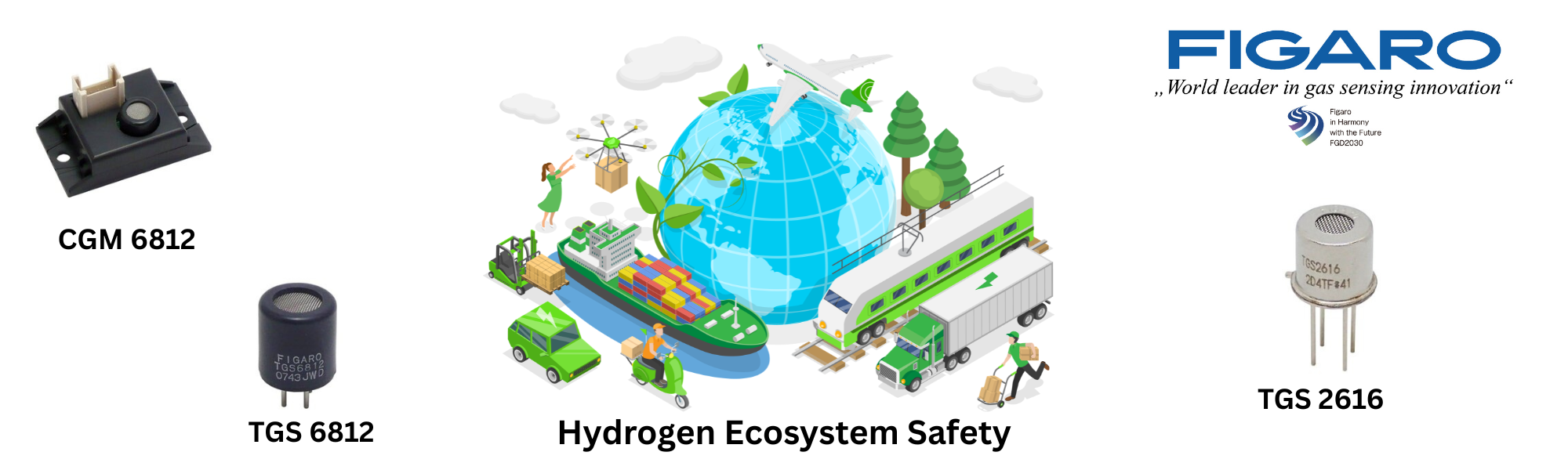
Der katalytische „Perlen-Sensor“ TGS6812 von Figaro ist nach wie vor eine bewährte Lösung für die breitbandige Erkennung brennbarer Gase in Anwendungen der Arbeitssicherheit. Seine Stärke liegt in Umgebungen, in denen mehrere Gase gleichzeitig vorhanden sein können, wodurch er sich besonders gut für die industrielle Fertigung und chemische Anlagen, Versorgungsunternehmen und Gasverteilungsinfrastrukturen sowie Stromerzeugungssysteme mit gemischten Brennstoffen eignet. Der katalytische Gassensor TGS6812-D00 kann Wasserstoffkonzentrationen von bis zu 100 % UEG erkennen und zeichnet sich durch hohe Genauigkeit, gute Haltbarkeit, Langzeitstabilität, eine schnelle Ansprechzeit und eine lineare Ansprechkurve aus. Er erkennt sowohl Wasserstoff als auch andere brennbare Gase wie Methan und LPG und eignet sich daher gut zur Überwachung von Gaslecks in stationären Brennstoffzellensystemen, die diese Brennstoffe in Wasserstoff umwandeln.
Der TGS6812 lässt sich nahtlos in bestehende Sicherheitssysteme integrieren und erfüllt gängige Normen wie EN 60079-29-1. Damit ist er die ideale Wahl für stationäre Gasmessanwendungen, bei denen zuverlässige Leistung, Kompatibilität mit etablierten Systemen und die Erkennung mehrerer Gase für die Sicherheit und den Explosionsschutz von entscheidender Bedeutung sind.
Das Figaro CGM 6812 Sensormodul baut auf der Leistungsfähigkeit des TGS6812 auf und bietet ein vorkalibriertes, temperaturkompensiertes Modul mit linearisiertem Ausgang, was die Systemauslegung für OEMs erheblich vereinfacht. Dies ist besonders vorteilhaft in groß angelegten oder verteilten Sicherheitssystemen wie Gasübertragungsnetzen, Chemieanlagen und Wasserstoffanlagen, wo eine konsistente Leistung über mehrere Messpunkte hinweg erforderlich ist. Das Modul reduziert den Bedarf an komplexen analogen Schaltungen, interner Kalibrierung und Kompensationsalgorithmen und ermöglicht so schnellere Entwicklungszyklen, verbesserte Zuverlässigkeit und niedrigere Gesamtbetriebskosten. Sein integriertes Design unterstützt zudem den Plug-and-Play-Einsatz und eine einfachere Zertifizierungsanpassung, was es zu einer attraktiven Option für OEMs macht, die sicherheitskritische Gasdetektionssysteme für ein breites Spektrum industrieller Anwendungen entwickeln.
Der TGS6A10 steht für eine neue Generation wasserstoffspezifischer katalytischer Sensorik, die speziell für die Anforderungen der rasch wachsenden Wasserstoff-Ökosysteme entwickelt wurde. Er ist für die Erkennung von 0–4 Vol.-% Wasserstoff optimiert und eignet sich besonders für Elektrolyseure, Wasserstoffproduktionsanlagen, Hochdruckspeichersysteme und Fahrzeugtankstellen sowie für die Stromerzeugung auf Basis von Brennstoffzellen. Entwickelt gemäß den Anforderungen für Brennstoffzellen-Elektrofahrzeuge (FCEV), bietet er eine schnelle Ansprechzeit, Langzeitstabilität (über 15 Jahre ohne Wartung) und Beständigkeit gegen Siloxanvergiftung, wodurch ein zuverlässiger Betrieb in rauen und kontaminationsanfälligen Umgebungen gewährleistet ist. Mit seinem kompakten, leichten, stromsparenden Design und seiner hohen Langlebigkeit bietet der TGS6A10 eine zukunftsfähige Lösung für die Wasserstoff-Sicherheitsüberwachung, bei der Präzision, Langlebigkeit und minimaler Wartungsaufwand entscheidend sind.
Einsatz im TOYOTA MIRAI
Der TGS6A10 kommt bereits im neuesten wasserstoffbetriebenen Fahrzeug von TOYOTA, dem MIRAI, zum Einsatz und erfüllt die strengen Leistungs- und Qualitätsstandards von TOYOTA sowie die GTR-13 (Global Technical Regulation No. 13 on Safety of Hydrogen and Fuel Cell Vehicles), den Sicherheitsstandard für FCEV-Sensoren. Das Sensormodul ist als CSD-05 (mit PWM-Ausgang) oder CSD-04 (mit CAN-Schnittstelle) erhältlich.
MOS-Sensoren:
Der Figaro TGS 2616-C00 ist für den Einsatz in tragbaren Gasdetektoren und zur Lecksuche bei Gasgeräten konzipiert und ergänzt primäre Detektionssysteme, die auf katalytischen oder Infrarotsensoren basieren. Das Gerät unterstützt einen kostengünstigen Einsatz an mehreren Standorten und eignet sich daher gut für die entstehende Wasserstoffinfrastruktur, wie beispielsweise Elektrolyseurgebäude, Lagerräume und Produktionsstätten für Brennstoffzellen. Mit seiner hervorragenden Selektivität für geringe Wasserstoffkonzentrationen und seiner Detektionsfähigkeit im ppm-Bereich bietet es schnelle Reaktionszeiten, die angesichts der schnellen Ausbreitung von Wasserstoff und seiner geringen Zündenergie von entscheidender Bedeutung sind. Der Sensor eignet sich zudem gut für Anwendungen mit Methan-Wasserstoff-Gemischen und trägt so dazu bei, Systemkonzepte zukunftssicher zu gestalten.
Figaro Engineering Inc.