
Produkt-Neuheit
Figaro-Sensoren für erstickende Gase in Anwendungen der Arbeitssicherheit
16.04.2026
In der Arbeitssicherheit ist die Überwachung auf Sauerstoffmangel (O₂) und erstickende Gase wie Kohlendioxid (CO₂) und Kältemittel von entscheidender Bedeutung in Umgebungen, in denen Gase den Sauerstoff verdrängen und ohne Vorwarnung lebensbedrohliche Zustände hervorrufen können.
Typische Anwendungsbereiche sind beengte Räume (z. B. Tanks, Versorgungstunnel, Abwasseranlagen), CO₂-Speicher- und -Nutzungsbereiche (z. B. Getränkeherstellung, Kühlhäuser, CO₂-Abscheidungssysteme) sowie Kälteraum und HLK-Anlagen, die moderne Kältemittel mit niedrigem Treibhauspotenzial (GWP) verwenden. In diesen Anwendungen müssen Detektionssysteme hohe Zuverlässigkeit, schnelle Reaktionszeiten und eine stabile Langzeitleistung bieten, wobei besonderer Wert auf einen ausfallsicheren Betrieb bei der O₂-Überwachung und die genaue Erkennung von CO₂- und Kältemittelansammlungen gelegt wird, bevor gefährliche Zustände entstehen. In diesem Zusammenhang bietet das Portfolio von Figaro Engineering Inc. eine Reihe sich ergänzender Sensortechnologien:
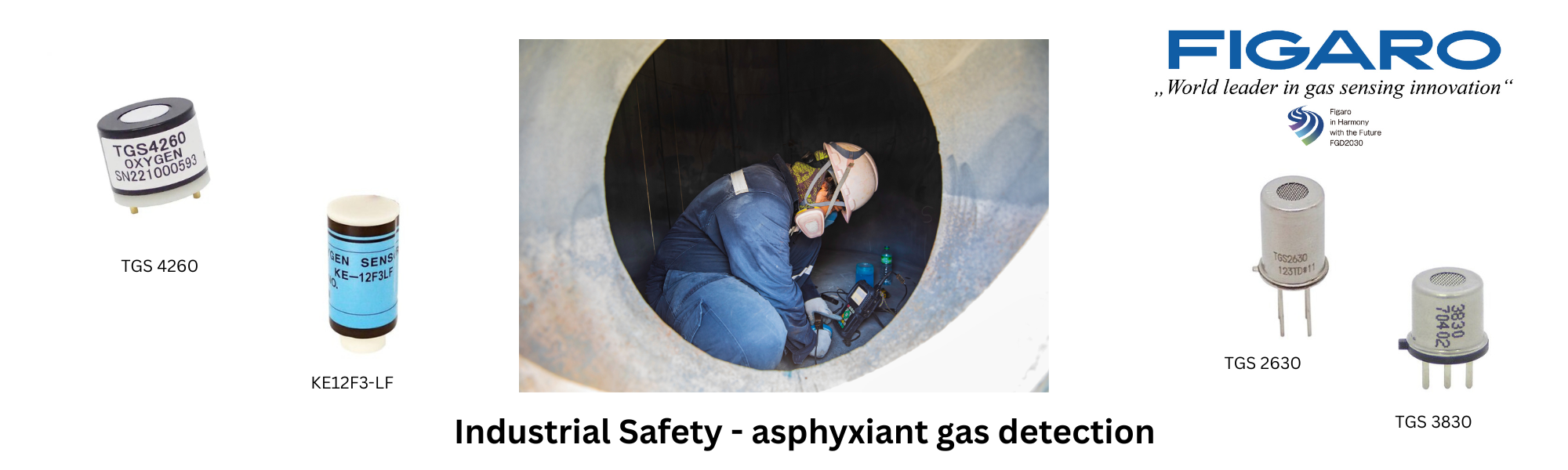
Der Figaro TGS 4260 eignet sich hervorragend für die stationäre Überwachung des Sauerstoffmangels in Umgebungen wie Inertgas-Schutzsystemen, Stickstofflagerbereichen und beengten Räumen. Er ermöglicht eine kontinuierliche Messung über einen typischen Bereich von 0–25 % O₂ und deckt damit sowohl Sauerstoffmangel- als auch Sauerstoffanreicherungszustände ab. Sein Hauptvorteil liegt in seiner langen Betriebsdauer von mindestens 5 Jahren und seiner wartungsfreien Bauweise, da er ohne Verbrauchselemente auskommt. Dank seiner guten Langzeitstabilität, seiner hohen Selektivität gegenüber O₂ und seiner Unempfindlichkeit gegenüber Umgebungsschwankungen eignet er sich besonders für Festinstallationen, bei denen geringer Wartungsaufwand entscheidend ist.
Der Figaro KE12F3-LF ist ein galvanischer elektrochemischer Sensor, der für die hochpräzise und reaktionsschnelle Sauerstoffüberwachung in sicherheitskritischen Anwendungen wie dem Betreten von beengten Räumen und ortsfesten Sicherheitssystemen entwickelt wurde. Er bietet eine schnelle Ansprechzeit von weniger als 8 Sekunden und genaue Messungen im Bereich von 0–25 % O₂, wobei er praktisch keine Querempfindlichkeit gegenüber Gasen wie CO₂, H₂S oder SO₂ aufweist, was eine zuverlässige Erkennung und Alarmierung unterhalb kritischer Schwellenwerte (z. B. 19,5 % O₂) ermöglicht. Sein linearer Ausgang und seine hohe Empfindlichkeit ermöglichen eine sofortige Erkennung und schnelle Alarmreaktion, was ihn zur bevorzugten Wahl macht, wenn Sicherheit entscheidend ist. Der Sensor eignet sich zudem besonders gut für tragbare Gasdetektoren und Mehrgasmessgeräte, da er keine externe Stromversorgung und keine Aufwärmzeit benötigt, was einen sofortigen Betrieb und eine effiziente Batterienutzung ermöglicht. Diese Eigenschaften, kombiniert mit seinem kompakten Design und seiner stabilen Leistung, machen ihn ideal für die persönliche Sicherheitsüberwachung.
Bitte beachten Sie, dass beide oben genannten Sauerstoffsensoren bleifrei sind und die RoHS-2-Richtlinie erfüllen.
Figaro Engineering bietet derzeit keine spezielle Lösung für die CO₂-Überwachung im Bereich der Arbeitssicherheit an. Das NDIR-basierte Gerät Figaro CDM 7162 ist eher für die Überwachung der Raumluftqualität und die Lüftungssteuerung als für sicherheitskritische Anwendungen konzipiert. Sein Messbereich deckt nicht die höheren Konzentrationen (etwa 1–3 Vol.-% CO₂) ab, die mit einem akuten Erstickungsrisiko verbunden sind, und seine Ansprechzeit von etwa 90 Sekunden (T90) ist langsamer als typischerweise für die Auslösung eines Sicherheitsalarms erforderlich. Wichtig ist, dass CO₂ im Gegensatz zu Inertgasen wie Stickstoff oder Argon nicht allein anhand des Sauerstoffmangels sicher überwacht werden kann, da es giftig ist. Schädliche Auswirkungen, einschließlich Bewusstlosigkeit, können auftreten, bevor der Sauerstoffgehalt auf kritische Schwellenwerte fällt, weshalb eine direkte CO₂-Erkennung in Sicherheitsanwendungen unerlässlich ist.
Für die Erkennung von Kältemittelgasen bietet der Figaro TGS 2630 eine hohe Empfindlichkeit gegenüber einer Vielzahl von Kältemitteln in Konzentrationen unterhalb der Gefahrengrenze sowie Langlebigkeit und Unempfindlichkeit gegenüber Störgasen. Dank seiner schnellen Ansprechzeit ermöglicht er eine frühzeitige Leckerkennung, bevor es zu einer nennenswerten Sauerstoffverdrängung kommt.
Der Figaro TGS 3830 ergänzt dies durch eine kompakte Lösung mit geringem Stromverbrauch (120 mW gegenüber 280 mW beim oben genannten TGS 2630) und noch schnellerer Reaktionszeit, die sich für den intermittierenden Einsatz in tragbaren und Handgeräten wie Lecksuchgeräten und Inspektionsgeräten eignet.
Zwar zeichnen sich der TGS 2630 und der TGS 3830 durch eine frühzeitige Lecksuche und -überwachung aus, selbst in Bereichen mit hohem Erstickungsrisiko, doch erfüllen sie nicht die strengen sicherheitskritischen Leistungsstandards (z. B. EN 60079-29-1) und sollten daher in solchen Situationen nicht als primäre sicherheitskritische Sensoren dienen, sondern als ergänzende Hilfsmittel neben robusteren, zertifizierten Systemen.
Figaro Engineering Inc.